Christmas Light Contractors
A Christmas light contractor designs a holiday display for a specific building, installs it with commercial-grade product, keeps it lit through the season, takes it down in January and stores it until the next year. The part buyers underestimate is everything after installation day: insurance for crews working at height, a crew that comes back when a run fails in the third week of December, and a removal date in writing. Holiday Lights Decor has been doing this since 2006 and works across 10 states on the East Coast. Every photograph on this page is our own work, shot in 35 cities.
- Installing since
- 2006
- States served
- 10
- Documented installs
- 186 photos, 35 cities
- Quote turnaround
- 24 hours
What a contractor does that a handyman does not
Hanging lights is one afternoon of the job. A contract covers six things, and the price of any quote you receive is really the price of how many of the six are in it.
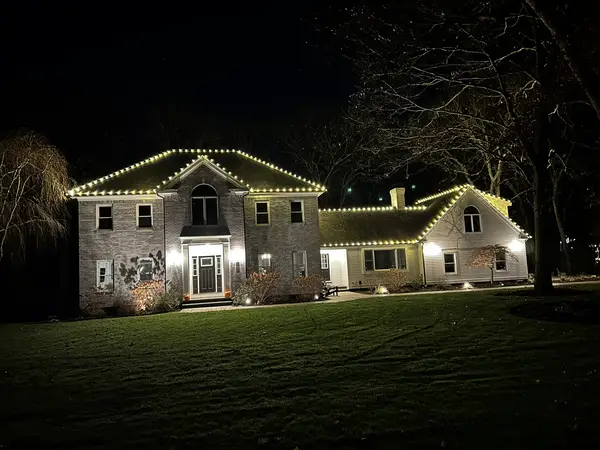
Design and measurement. Someone walks the property, measures the roofline in linear feet, decides where the run starts and stops so the display reads as a deliberate line rather than as whatever length of strand happened to be in the truck, and finds the power before installation day rather than during it.
Product. Commercial-grade LED built for outdoor winter service, cut and terminated to the measured length of your roof. Retail strands come in fixed lengths, which is why a big-box display always has a gap or an overlap somewhere.
Installation. Clips sized to your gutter, shingle or tile, never staples. Nothing that leaves a hole in the fascia when it comes off in January.
Service through the season. Weather takes out a run every year. The only question that matters is whether someone comes back.
Takedown. On a scheduled date in January, not on the first weekend a crew happens to be free in March.
Storage. Labeled by section, so next season is a reinstall rather than a redesign.
Five questions that separate the real ones
Ask these of everyone you call, including us. They sort the field faster than any review page will.
1. Can I see the certificate of insurance, with my address named on it?
Crews work at height, on ladders and roofs, in November weather. General liability plus workers compensation is the difference between a fall being the contractor problem and being yours. A company that carries both can produce the certificate the same day, and can have it issued naming your property. One that stalls is already telling you the answer.
2. Who owns the lights, you or me?
The industry runs on two models. In a lease, the contractor owns commercial-grade product, installs it, maintains it, removes it and stores it, and reuses it for years; you are paying for the display, not for the strands. In a purchase, you own the material and the contractor charges labor. Neither is wrong, but they price differently and they end differently, so find out which one you are buying before you compare two numbers.
3. Is takedown in this number, or billed later?
This is where most disputes start. Removal in January is real labor in real cold and it is priced accordingly. A quote that covers only installation looks cheaper in September and stops looking cheaper in the second week of January. Ask for the takedown month and whether storage is included.
4. A section goes dark on December 18. What happens?
Ask for the response window in writing. Season-long service means a crew comes back and fixes it while it still matters, at no extra charge. Without that commitment, a failure in the third week of December is simply a display that stays dark until January.
5. Are the crews your employees?
Trained employees who install the same system every week are the reason a roofline reads as one straight line from the street. Labor hired by the day for the season is the reason it does not. It also decides whose insurance is in play if someone is hurt on your property.
What actually moves the price
Two quotes on the same street can differ by a wide margin and both be honest. What drives the number is rarely the size of the house.
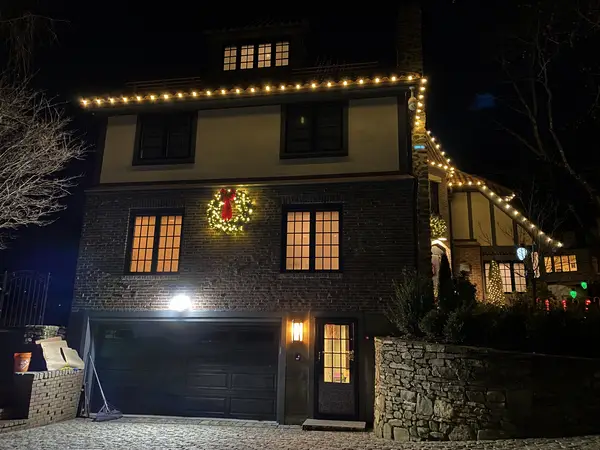
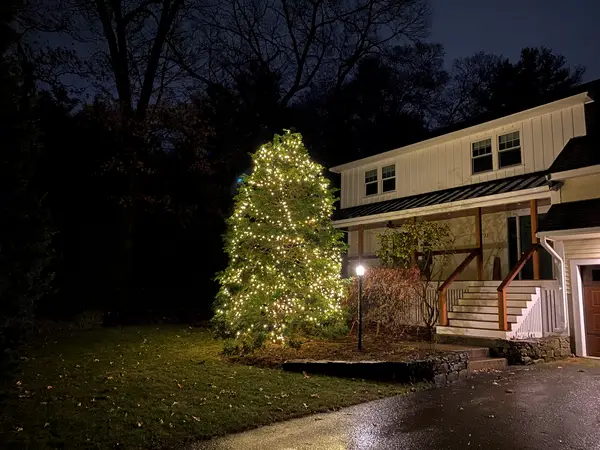
Linear feet of roofline is the base unit, not square footage and not the number of bedrooms. Access is the multiplier: a single-story ranch reached from a six-foot ladder and a three-story colonial with dormers over a sloped driveway are different jobs at the same footage. Trees are labor rather than material, because wrapping a trunk and branches by hand is slow, and one mature tree can cost more than an entire roofline. Commercial and municipal work adds scheduling around business hours, permits, lifts and traffic control.
We publish the breakdown instead of a headline number, because a headline number that ignores those four factors is only useful until the first real estimate arrives: what Christmas light installation costs and why.
Residential, commercial and municipal are different contractors
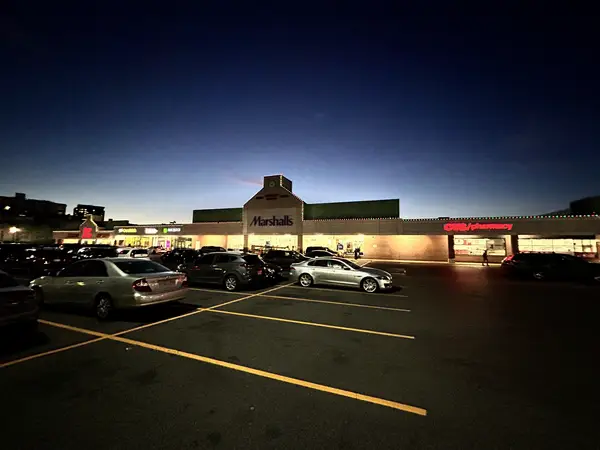
The equipment overlaps; the obligations do not. A residential job is measured in a driveway conversation. A retail center is measured in the hours the lot has to stay open, and a downtown program is measured in permits, road closures and a lighting date the mayor has already announced. Ask a contractor which of the three they do most. The honest ones answer immediately, and the answer should match your building.
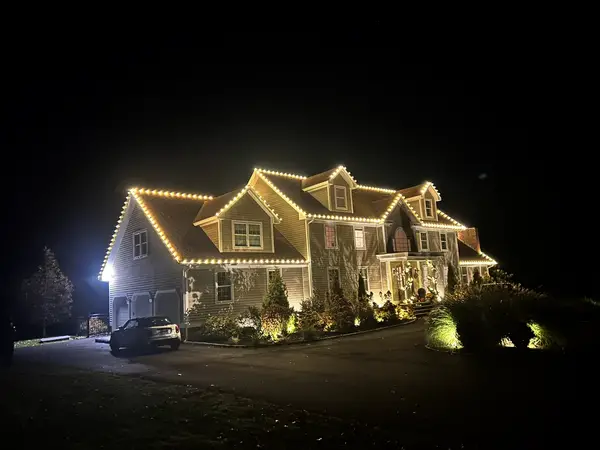
- Residential Christmas Lighting — Turnkey holiday light installation for homes, design, installation, maintenance, takedown, and storage.
- Commercial Holiday Lighting — Large-scale displays for retail centers, hotels, restaurants, and corporate campuses.
- Permanent LED Lighting Systems — Architectural permanent outdoor lighting, programmable color, app control, year-round accent.
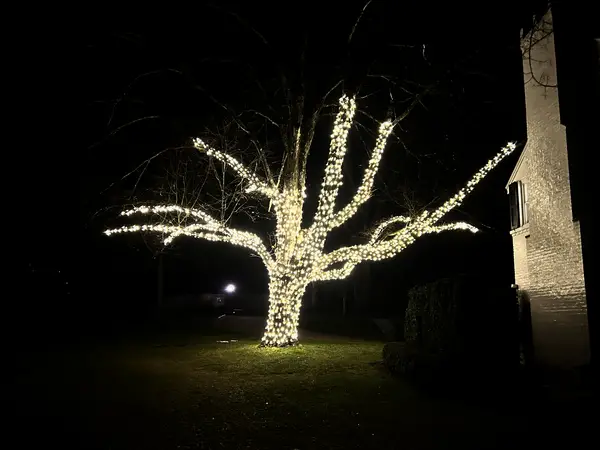
- Christmas Tree Lighting — Commercial-grade tree wrapping for residential landscape trees, town squares, and corporate campuses.
- Municipal & Downtown Lighting — Citywide holiday lighting programs, lamp posts, gazebos, town squares, and public displays.
- Removal & Storage — Post-season professional takedown, labeled storage, and multi-year rental programs.
Permanent lighting is a different contract entirely
Permanent architectural LED, sold under names like JellyFish, Trimlight, Gemstone and EverLights, is installed once, stays on the building year-round and is controlled from an app. There is no takedown, no storage and no seasonal service call, so most of the questions above simply do not apply. What you are buying instead is a one-time installation and a warranty, which makes the channel, the diode spacing and who honors that warranty in five years the things to compare.
We install these systems and we are not a dealer for any of those brands, which is why our buyer’s guides to permanent lighting brands can say what each one publishes and what it leaves out. If you already know you want it installed, that is the permanent lighting service.
Searching “near me”, and what to check first
A near-me search returns three kinds of result that look identical in the listing: national lead brokers who sell your address to whoever bids, seasonal crews assembled in October, and locally owned installers who worked your street last year. The listing does not tell you which is which, and the price does not either.
One question separates them. Ask whether the company answering the phone is the company that will be on the ladder. If the call routes to another state and someone will “match you with a local pro”, you are buying a referral, and the referral is resold. Our network is locally owned in every market: the person who measures your roofline lives there, the crew is theirs, and the same team comes back for the December service call and the January takedown.
The second question is how many seasons they have worked your town. A contractor who has taken lights down in your zip code in three consecutive Januaries has, by definition, survived three Februaries.
How to compare two quotes that are not the same quote
Bids are hard to compare because they rarely describe the same scope. One prices the front roofline. Another includes two trees and the walkway. A third quotes installation only and bills removal separately in January, which you find out in January.
Put every bid on one page with four columns: what is lit, whether the material is owned by you or by the contractor, whether takedown and storage are in the number, and what a mid-season service call costs. Then confirm the insurance in writing. A quote that is cheaper because it quietly dropped the takedown is not cheaper. It is a bill you have not received yet.
Where our crews work
Locally owned crews, one national standard for design, product and service. Each state below has its own team, and the portfolio is the proof: photographed street by street rather than licensed from a stock library.
Common questions
What does a Christmas light contractor do?
A Christmas light contractor designs the display for the specific building, supplies and installs commercial-grade product, services it through the season, removes it in January and stores it until the following year. The design and the after-installation half of that list are what separate a contractor from a handyman hanging strands you bought.
Are Christmas light contractors insured?
A professional one carries both general liability and workers compensation, and can send the certificate on request. Ask for it before work is scheduled, not after. Anyone working at height on your property without workers compensation coverage is an exposure that lands on your own policy.
Do Christmas light contractors provide the lights?
Most professional contractors do, and use commercial-grade LED product rated for outdoor winter service rather than retail strands. Some will install material you already own, but usually without warranting it, because consumer strands are not built to survive a season on a roofline and the failures come back as service calls.
Is takedown included in Christmas light installation?
It depends on the contractor, and it is the single most useful question to ask when two quotes look close. Removal, and often storage, are separate line items for some companies and included for others. Get the takedown month in writing.
When should I book a Christmas light installer?
Design and measurement happen best in late summer and early fall, and installation runs from October through the first week of December. Booking in November means taking whatever install date is left, and complex commercial and municipal displays are usually contracted months earlier.
How much do Christmas light contractors charge?
Price follows the linear footage of roofline, how hard that roofline is to reach, and how many trees are wrapped, since tree wrapping is almost entirely labor. A single-story ranch and a three-story colonial with dormers are not the same job. Our published cost breakdown works through what each factor adds.